

Table of Contents
(1) Decide on a Preferred School Type
One of the first steps that should be considered at the initial stage of your school search in Spain is: what type of school do you want your kids to go to? There is no shortage to the variety of schools available in Spain. We have private schools, concertado schools (charter), and public schools.
Within these three categories, you can further narrow things down by considering whether or not you want a “long” class day or a “short” class day. That is do you want jornada partida (an all day school, usually from around 9-4pm or sometimes even 9-5:30pm, depending on the school) or jornada continua (a short class day, a continuous day if you will- usually 9-2pm). Both school schedules have the option for lunch at school or home.
The nitty gritty details of how school in Spain functions can be found here.
The next thing to consider within this group is what type of school in Spain you are looking for- private schools alone come in all sorts of shapes and sizes (Traditional, Montessori, Free, Democratic, British, German, French, European, American, etc etc). Concertados are a mix of private and publicly funded- which means they can have some of their own teaching styles, curriculums, or formats (for example, a learning center, a catholic school, a secular school, a co-op type of pedagogy, etc).
After you have a general idea of what you PREFER, but are not STUCK ON, because that is the worse thing you can do in Spain- to get STUCK on something, you will want to move on to the following considerations.
How I got stuck in the beginning, is explained here.
(2) Look at the enrollment data for the first level of the infantil course (specific to Zaragoza, Spain and the equivalent of preschool in the United States)
I once had a local “zaragozano” write to me while I was on a school search here in Zaragoza, Spain. She told me that one way that she assesses the “goodness” of a school, is by looking at the data for enrollment data for the first level of infantil. This data is put out by the Aragon school system every year.
The method that she explained to me to use is really quite easy, but she stressed that is not a 100% guaranteed method, it just gives you an idea of what the surrounding population thinks of the school- if many people are trying to get their 3 year old into a specific school, then that is a positive indicator for the school.
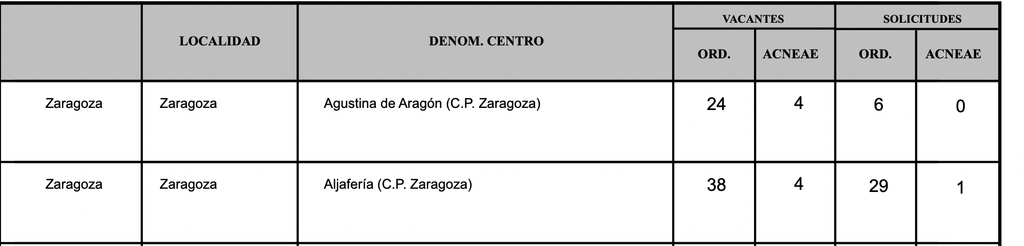
Simply put, you only need to look at the column for “Vacantes” (Vacancies), versus “Solicitudes” (Essentially, applications submitted). Below, I will share a screenshot of the 2026-2027 data for the first of infantil, again this is for 3 year olds. It is the equivalent of preschool in the United States.
Looking at Agustina de Aragon (the first school listed in the screenshot below), you see 24 “ord vacantes”, that is “ordinary vacancies”, alongside 6 “ord solicitudes”, which is “applications submitted”. On the other hand, for Aljaferia, you see 38 vacancies, along side 29 applications submitted. Between the two, one could infer that one school is more sought out over the other. The difference between 24 and 6 is larger than the one between 38 and 29.
This may not mean anything about the school, it could have something to do with school location. If the school happens to be the only school in a neighborhood, then it is obviously going to get a lot of applications, whereas a school located in a neighborhood with multiple schools available, may not attract so many applicants. For this reason, it is important to use this information as a tool to guide you, but not as the only resource. Here is the full document.
(3) Read reviews for the schools
Unlike in the United States, in Spain it is very difficult to find reviews of schools. Google has deactivated the ability to review or read old reviews of schools on their google maps app. There are some other options though. One is Micole.
The caveat with this website is that if a school in Spain does not actively request families to leave a review, then you may not find many reviews for the schools you are looking at. This website will also give you some of the basic information about the school in Spain, but it is not always accurate. You can find out things like: languages offered at the school, what extracurriculars are available, the price range of tuition, and even if they have attention to diversity.
I recommend using this only as a tool as well, since most of the information is “scraped” from school in Spain websites, which actually are not always up-to-date. You don’t want to hang your whole decision on this webiste.
(4) Word of Mouth
This one is tough, especially for people new to the country, city, etc. It can be difficult to find people who have attended the schools you are considering. It can be impossible if you can’t communicate in Spanish with people, in order to ask your neighbors about schools.
Sometimes you will get lucky and find the owner of the home you rent as some local information about schools.. maybe they send or sent their kids to one school or the other, and thus have a preference for that school and can share it with you. One sometimes decent option for getting a combo of “word of mouth” and “reading reviews” is to access facebook groups.
One group that I have found particularly helpful in Zaragoza is the Mamas Zaragoza group. It is only useful if someone has asked recently about the schools you are interested in, BUT it is very common in this group to post and ask about a whole list of schools that you are researching, so feel free to do so. Remember that google translate is your friend :).
(5) Visit Schools
Ideally, you would come to Spain during open house season (January to April), visit schools, find an apartment, and do the enrollment process during the regular enrollment period (usually sometime in April), with your padron and immigration card in hand, BUT that is not reality for most people… so how can you accomplish something similar?
One option is to obsessively research the schools via their websites. Sometimes they have virtual tours only, but not always. Some schools will also have social media, which can give some strong insight into the school in Spain. You can write an email or call the school in Spain and ask if they can do a tour over a video call.
You could visit Spain as a tourist and just walk into a concertado or private school and ask for a tour (will not work for a public school). Explain to them that you are visiting, or that you have just arrived, etc and that you were not here during the regular open house season. Some schools have an open door policy, and will take you around right away. Others will make an appointment for you to come back and visit the school, still others will just say no and you will be on your way.
Whatever you do, do not think you can visit or move to Spain in August and get any of this accomplished. You won’t, because everything shuts down in August. Most of all of the school staff will be on vacation. The best time of year to visit a school in Spain is going to be during the school year, during normal school hours, not in July, August, Semana Santa, Christmas Break, etc. It will end up being a timeframe that is wildly inconvenient for your actual life, but that is because the calendar and schedules right immensely different than wherever you are from.
(6) Remain Flexible
Even after all of the work that you will have done up to this point, ultimately, you have almost no control over where your child will go to school in Spain, unless you enroll them in a private school in Spain that has space, which comes with it’s own set of problems. After completing all of the research, visiting the schools, talking to neighbors, etc, it will be time to enroll in a school in Spain.
In Zaragoza, this process is done online, with one exception- IF you move here after school starts, go and visit a CONCERTADO that has space for your child, AND LIKE IT, you can ASK them if they can enroll your child right then and there. Even if you don’t have your residency card or padron, it is still possible. This does not mean that they WILL, it just means that they can and that you can ask.
Assuming that you follow all of the typical steps, timing, and processes, you will use the online system to apply, you will be ranked by points, and you will wait a couple of weeks (at least) to get a response.
I have talked about this full process in a series of School in Spain videos, which I made in order to document the process that we went through while looking for a secondary school spot for our oldest son. As of this writing, it is August.. we started this in January with school visits, and I am still not 100% confirmed on which school in Spain he is starting at in two weeks time, so pack your patience dear.
Here is the first from the series of “School in Spain” from my youtube channel. Please consider subscribing.
School in Spain is a broad topic, and it varies vastly across the country. If you are looking for specific information about schools in Zaragoza Spain, I accept bookings for consultations, here.
Feel free to also watch my Schools in Spain Playlist on youtube, and leave your questions in the comments. I am happy to answer them there as well.
